
PUPPY BITING: WHY IT HAPPENS AND HOW TO HANDLE IT
- Emily

- May 20
- 5 min read
If your puppy is sinking their teeth into your hands, ankles, and clothes on a daily basis, you're not alone. Puppy biting is one of the most common reasons new owners reach out for help, and it's also one of the most misunderstood. The good news is that with the right approach, it does get better.
Here's everything you need to know.
JUMP TO SECTION
WHY DO PUPPIES BITE?
Puppies bite for lots of different reasons, and understanding why yours is doing it makes a big difference to how you respond.
The most common reasons include:
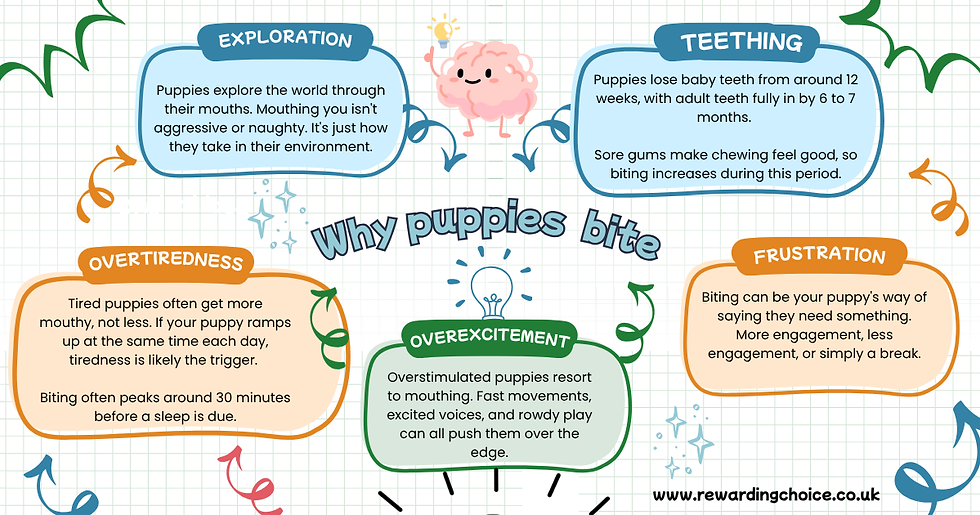
Exploration:
Puppies experience the world through their mouths. Mouthing you isn't necessarily aggressive or naughty. It's often just how they're taking in their environment.
Teething:
Puppies start losing their baby teeth around 12 weeks old, and adult teeth come in by around 6 to 7 months. Sore gums make chewing feel good, so biting and mouthing increases during this period.
Overtiredness:
This one catches a lot of owners off guard. Tired puppies often become more mouthy and bitey. If your puppy seems to ramp up around the same time each day, tiredness is likely the trigger.
Pro Tip: Biting tends to be worse around 30 minutes before your puppy is due a sleep
Overexcitement or high arousal:
Overstimulated puppies often resort to mouthing. Fast movements, excited voices, and rowdy play can all tip them over the edge.
Frustration:
Sometimes biting is your puppy's way of saying they need something. More engagement, less engagement, or simply a break.
Reinforced behaviour:
If biting reliably gets a reaction from you, whether that's laughter, attention, or a game, your puppy learns it works. From your puppy's point of view, the behaviour has been "reinforced" (or rewarded) so it's likely to increase.
WHY IS MY PUPPY BITING SO MUCH?
If it feels relentless, it probably is. Young puppies have very little impulse control and very sharp teeth, which is a difficult combination. By 12 weeks their jaw strength is increasing, and by 18 weeks those bites can really hurt.
The most likely reason your puppy is biting a lot is that they're overtired. lt's worth looking at how much structured rest they're getting. Puppies need a lot of sleep, and when they don't get enough, the biting tends to get worse.
HOW TO STOP PUPPY BITING
The most important thing to understand is that there's no single fix. How you respond needs to match why your puppy is biting in the first place.
Here's a simple breakdown:
If your puppy is gently mouthing during a cuddle, stay calm and slowly move your hands away. Avoid sudden movements, which can turn the whole thing into a game. Gently end the interaction if needed.
If your puppy is playful and nippy, redirect them onto a toy or chew. Keep your voice calm and your movements slow. Your goal is to bring their energy down, not match it.
If your puppy is biting for attention, give them a short training game or some structured toy play instead. You're not ignoring them. You're giving them a better way to engage with you.
If your puppy is doing zoomies or seems hyper, the chances are they're actually overtired. Guide them to a calm space and encourage a nap.
If nothing is working in the moment, try a calming activity like scatter feeding, sniffing, a food puzzle, or a long-lasting chew.
WHAT NOT TO DO WHEN YOUR PUPPY IS BITING
One thing to avoid: the yelping technique. You might have read that making a high-pitched yelp when your puppy bites, to mimic a littermate, will make them stop. In practice, it tends to increase excitement levels. If your puppy is already overstimulated or overtired, they're likely to come back and bite harder.
Punishment in any form, including pointing, saying "ah ah", spraying water, or making loud noises, is also something to steer clear of. These approaches carry a real risk of creating anxiety and fearful behaviour, and they don't address why the biting is happening.
WHEN DOES PUPPY BITING STOP?
Most of the teething-related biting will reduce as your puppy gets their adult teeth, which usually come through fully by around 6 to 7 months.
That said, how long biting lasts overall depends on your individual puppy. Breed, how consistently you've responded to the biting, and whether the behaviour has been accidentally rewarded all play a role. Some puppies settle down much earlier. Others take a little longer.
What you can do is make sure you're not reinforcing it, that your puppy is getting enough rest, and that they have plenty of appropriate things to chew on.
IS MY PUPPY BEING AGGRESSIVE? WHY IS MY PUPPY BITING AND GROWLING?
This question comes up a lot, and the honest answer is that most of the time, no, your puppy is not being aggressive.
Young puppies who growl or bite hard are usually overexcited, overtired, or over-aroused. It looks intense, but it's typically normal communication. Meeting it with calm redirection rather than panic or punishment is nearly always the right move.
That said, there are some situations where the biting is worth taking more seriously. These include:
Deliberate snapping or biting when you try to take away food, a toy, or a bone. This is a guarding behaviour and sits outside the category of normal puppy biting.
Sudden, unprovoked biting in a puppy that was previously gentle. If there's been no obvious trigger and the behaviour comes out of nowhere, that warrants a closer look.
Biting when you touch specific parts of their body. This can sometimes indicate pain, so a vet check is a good first step.
Mouthing that isn't tapering off as your puppy approaches 6 to 9 months and starts getting their adult teeth. By this point, most puppies are naturally biting less. If yours isn't, it's worth getting some professional support.
PUPPY BITING AND CHILDREN
Puppy biting is especially common around children. Puppies get overstimulated by fast movement, squealing, and unpredictable energy, and children unintentionally provide all three.
The key is managing interactions carefully, especially in the early weeks.
A few things that help:
supervise all contact between your puppy and your children
avoid letting them run, squeal, or wave their arms around the puppy
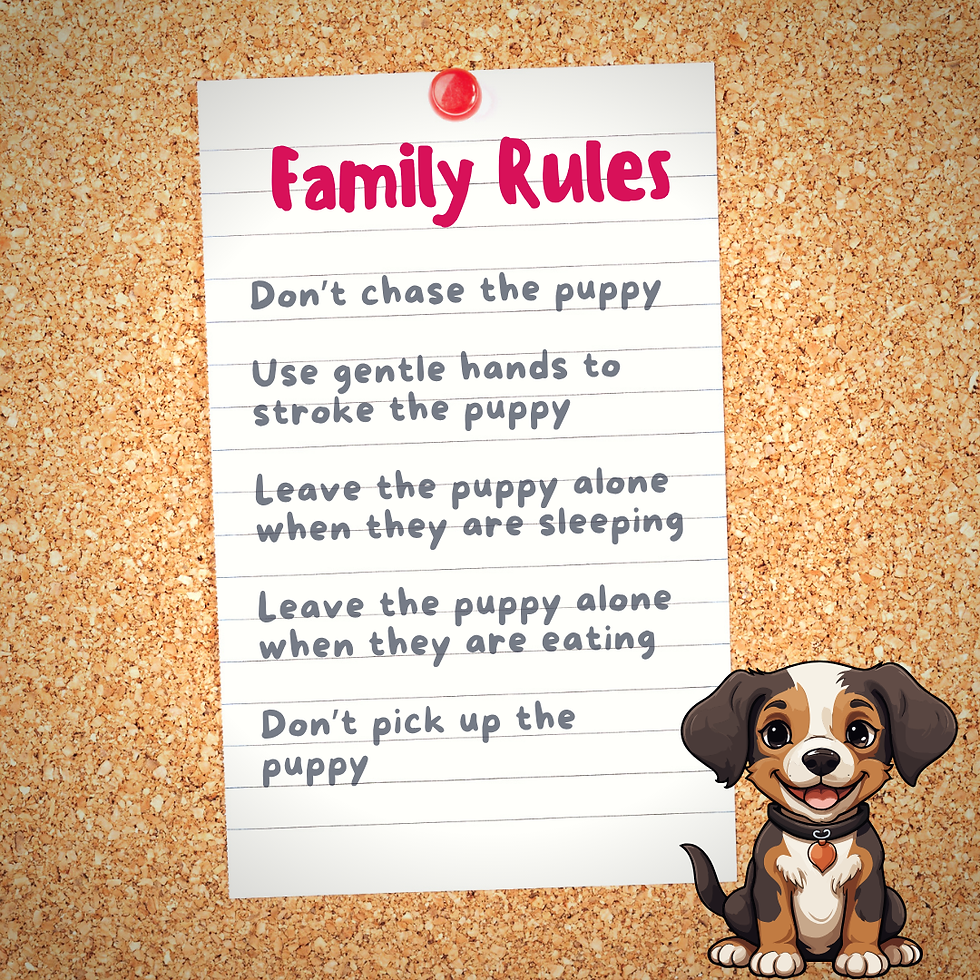
set some simple family rules. Things like stroking with one hand, not chasing the puppy, and leaving them alone when they're sleeping or eating
It's also worth setting up some calm routines at flashpoint moments.
Mornings, for example, can be chaotic. Getting your puppy up before the children, giving them a short training session or scatter feed in the garden, and settling them in their crate with a chew before the children come down can reduce a lot of the early morning chaos.
THE BIGGER PICTURE
Puppy biting is hard. It's painful, it's relentless, and it can make you question whether you've made a terrible mistake. You haven't.
Small, calm responses, applied consistently, make a real difference over time. You don't need to get it right every single time. You just need to keep going.
If you're struggling and want some tailored support, that's exactly what the Rewarding Choice puppy programme is here for. Find out more at www.rewardingchoice.co.uk or book a free 30-minute discovery call here.
What's your biggest takeaway? Tell me in the comments.

Comments